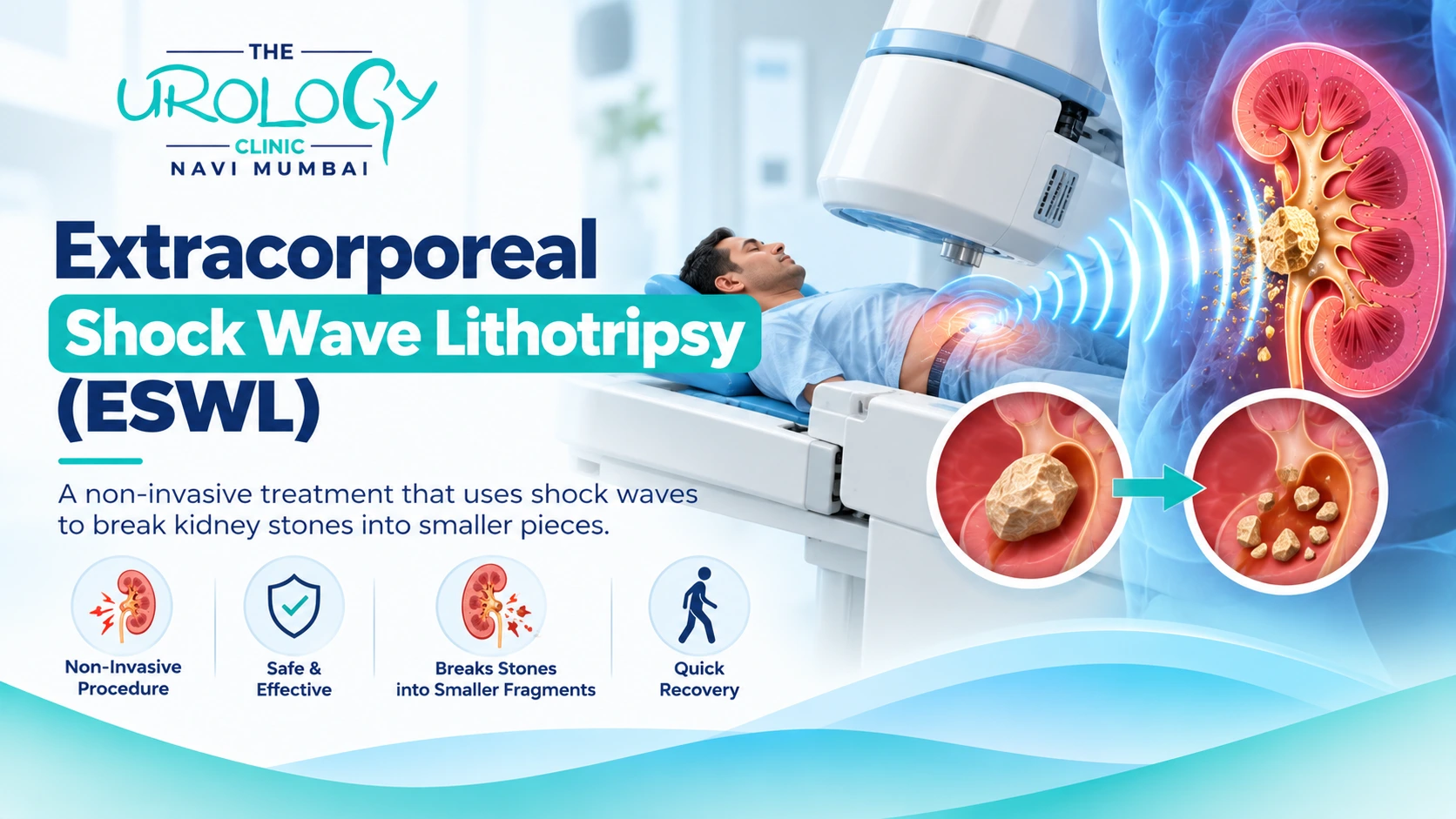


Kidney stones can cause intense pain, discomfort during urination, nausea, and blood in the urine. Some small stones may pass naturally without a procedure, while others can remain in the kidney or become lodged in the urinary tract. Treatment depends on the stone’s size, location, composition, associated symptoms, and whether it is affecting normal urine flow.
One treatment option for selected kidney and ureteric stones is Extracorporeal Shock Wave Lithotripsy (ESWL). This minimally invasive procedure uses focused shock waves generated outside the body to break a stone into smaller fragments. These fragments can then pass through the urinary tract with urine over time. Since ESWL usually does not require an incision, it may be suitable for patients who meet the medical criteria for this treatment.
However, ESWL is not the right choice for every kidney stone. Some stones are too large, too hard, or located in a position that makes shock wave treatment less effective. A urologist assesses the patient’s condition and imaging results before recommending ESWL or another treatment option.
Extracorporeal Shock Wave Lithotripsy is a medical procedure used to break certain kidney and upper urinary tract stones into smaller pieces. The word “extracorporeal” means outside the body, while “lithotripsy” refers to breaking stones. The procedure allows the treatment team to target a stone without surgically opening the body.
During ESWL, a specialised machine produces shock waves that are directed towards the stone. Ultrasound or X-ray imaging may be used to locate the stone and guide treatment. When the waves reach the stone, they create pressure that gradually breaks it into smaller fragments. The body can then pass these fragments through urine.
ESWL is generally performed without making a surgical incision. Depending on the patient’s condition and the facility’s protocol, the procedure may be carried out as a day-care treatment. Some patients need pain relief or sedation during treatment, and the exact approach depends on their medical needs.
It is important to distinguish ESWL from other stone treatments. Ureteroscopy involves passing a thin instrument through the urinary tract to reach and treat a stone, while percutaneous nephrolithotomy (PCNL) involves accessing the kidney through a small incision in the back. The choice between these procedures depends on the stone and the patient’s overall health.
ESWL may be considered for selected kidney stones and certain ureteric stones when their size, location, and other characteristics make shock wave treatment appropriate. Smaller stones are generally more likely to respond than larger stones, although stone size alone does not determine whether the procedure will work.
A urologist may consider ESWL when a stone is causing symptoms, is unlikely to pass naturally, and can be targeted effectively. Imaging tests help determine the stone’s position and size, while other investigations may assess kidney function and check for signs of infection or obstruction.
Several factors influence whether ESWL is appropriate. These include the stone’s size, location, hardness, and density on imaging. Certain stone compositions are more resistant to shock waves, and stones in some locations may be less likely to clear completely after treatment.
The patient’s medical history is also important. Pregnancy, certain bleeding disorders, uncontrolled infections, anatomical differences, and some other medical conditions may make ESWL unsuitable or require special precautions. Blood-thinning medicines may also need careful review, but patients should never stop prescribed medication without instructions from their treating clinician.
ESWL may not be the preferred option for very large stones, stones that are difficult to target, or stones that are unlikely to break effectively. A stone causing significant urinary obstruction or an infection may require urgent management rather than routine stone-breaking treatment.
Alternatives include ureteroscopy, laser lithotripsy performed during ureteroscopy, and PCNL. In some situations, treatment may first be needed to relieve an obstruction or manage an infection. The urologist recommends an approach based on the clinical findings rather than assuming that one procedure is suitable for everyone.
The ESWL process usually involves preparation, treatment, and post-procedure monitoring. The details may vary depending on the equipment used, the stone’s characteristics, and whether the patient needs sedation or other pain relief.
Before the procedure, the medical team reviews the patient’s medical history, current medicines, allergies, previous stone treatments, and imaging reports. Urine tests, blood tests, or additional imaging may be required. These assessments help identify infection, evaluate relevant health risks, and confirm the treatment plan.
Patients receive instructions about eating, drinking, and taking regular medicines before the procedure. These instructions are particularly important if sedation or anaesthesia is planned. The patient should clarify any medication-related questions with the treating team before treatment.
During the procedure, the patient lies on a specialised treatment table. The medical team uses imaging, such as ultrasound or X-ray, to locate the stone and position the equipment accurately. The shock wave device then delivers a series of focused waves towards the stone.
Pain relief or sedation may be provided depending on the patient’s needs and the treatment protocol. The shock waves are intended to break the stone into fragments small enough to pass through the urinary tract. The duration varies according to the stone and the equipment used.
The medical team monitors the patient throughout treatment and checks their condition afterwards. ESWL does not usually require an incision, but the procedure may not remove every fragment immediately. Additional treatment or follow-up may be necessary if the stone does not break adequately or the fragments fail to pass.
Some patients experience discomfort while shock waves are delivered. The level of discomfort varies, so the medical team may provide appropriate pain relief or sedation. The patient should tell the team if the discomfort becomes difficult to tolerate.
Mild soreness, bruising around the treatment area, or temporary discomfort as stone fragments move through the urinary tract may occur after treatment. The intensity and duration vary from person to person. The treating team can advise which symptoms are expected and which require medical attention.
One of the main benefits of ESWL is that it can break selected kidney stones without making a surgical incision. For suitable patients, it may offer a less invasive alternative to procedures that require instruments to reach the stone directly or an incision to access the kidney.
Many patients can return home on the same day, depending on their condition and the facility’s protocol. Recovery may be shorter than with more invasive procedures, and normal activities can often be resumed gradually according to medical advice.
Another advantage is that ESWL can target a stone from outside the body. This may make it a suitable option for certain patients who meet the clinical criteria. However, the procedure’s effectiveness varies. Stone size, location, hardness, body characteristics, and the ability of fragments to pass through the urinary tract can influence the outcome.
Some patients need more than one ESWL session, while others may require ureteroscopy or another procedure if fragments remain. The expected benefits and limitations should be discussed with the urologist before treatment.
Although ESWL is generally considered safe for appropriately selected patients, it can cause side effects and complications. Understanding these possibilities helps patients recognise expected symptoms and know when to seek medical care.
Blood in the urine is a common temporary effect after treatment. Mild pain, bruising, or soreness around the treatment area may also occur. These symptoms often improve, but their duration can vary. Patients should follow the instructions provided by their healthcare team.
In some cases, stone fragments may collect in the ureter and obstruct urine flow. This is known as steinstrasse and may require additional treatment. Other possible complications include incomplete stone clearance, urinary tract infection, and, rarely, injury to surrounding tissues.
The risk of complications depends on factors such as the patient’s health, stone characteristics, and the treatment approach. Some patients may need additional imaging or another procedure to confirm that the urinary tract is clear.
A fever or chills after ESWL may indicate an infection and should not be ignored. Severe or worsening pain, persistent vomiting, difficulty passing urine, or a marked reduction in urine output also requires prompt medical assessment. Patients should follow the discharge instructions and use the emergency services available to them if symptoms are severe.
Recovery after ESWL varies according to the patient’s health, the size and location of the stone, and how the body responds to treatment. Many patients can return home within a short period, but they should follow the instructions given by their healthcare team rather than assuming that normal activity can resume immediately.
Mild discomfort and pink or reddish urine may occur temporarily. The medical team may prescribe pain relief or other medicines when appropriate. Patients should take medicines only as directed and should ask the treating clinician before using additional medicines, particularly if they have kidney disease or take blood-thinning medication.
Drinking an appropriate amount of water may help stone fragments pass through urine. However, fluid intake should be individualised, especially for people with kidney, heart, or other conditions that require fluid restrictions. Patients should also follow advice about physical activity, driving after sedation, and returning to work.
Stone fragments may pass over several days or weeks. The time depends on their size, number, location, and the individual’s urinary tract. Some fragments pass without noticeable symptoms, while others may cause temporary discomfort as they move towards the bladder.
Not every stone is cleared after a single ESWL session. Follow-up imaging may be recommended to check whether the stone has broken down and whether any fragments remain. If the fragments do not pass or continue to cause symptoms, the urologist may discuss additional treatment.
Patients should seek prompt medical assessment if they develop fever, chills, severe or worsening pain, persistent vomiting, difficulty passing urine, or a significant reduction in urine output. These symptoms may indicate infection or urinary obstruction.
Persistent blood in the urine or symptoms that do not improve as expected should also be discussed with the treating team. Following the recommended follow-up schedule can help identify retained fragments and other problems before they become more serious.
Kidney stones can develop again even after successful ESWL treatment. The procedure breaks existing stones, but it does not automatically remove the underlying factors that caused them. Prevention depends on the stone’s composition, the patient’s medical history, dietary habits, and any metabolic or medical conditions that increase stone risk.
Maintaining suitable hydration can help reduce the concentration of substances that form stones. Many people benefit from drinking enough fluid to produce a reasonable volume of urine, but individual needs vary. Anyone with a prescribed fluid restriction should follow their clinician’s advice rather than increasing water intake independently.
Reducing excessive salt intake and maintaining a balanced diet may also help. Calcium intake should not be restricted without medical advice, as dietary calcium can play a role in reducing the absorption of oxalate in the gut. Specific dietary recommendations depend on the type of stone and the person’s risk factors.
When possible, analysing a passed or removed stone can help identify its composition. Depending on the patient’s history and likelihood of recurrence, the urologist may recommend blood tests or a 24-hour urine evaluation to assess factors that contribute to stone formation.
The results may guide personalised dietary changes or preventive medicines. Follow-up is particularly important for people who have recurrent stones, multiple stones, a family history of kidney stones, or medical conditions that increase their risk. Prevention plans should be based on the clinical assessment rather than a one-size-fits-all diet.
ESWL is one of several treatment options for kidney stones. The most appropriate choice depends on the stone’s size, location, density, symptoms, and the patient’s overall health. The urologist may also consider whether the stone is causing obstruction, whether infection is present, and how likely the stone is to clear with a particular treatment.
Ureteroscopy involves passing a thin scope through the urinary tract to reach the stone. A laser may be used to break the stone into smaller pieces, which can then be removed or passed naturally. This approach may be preferred for certain ureteric stones or when ESWL is less likely to be effective.
Percutaneous nephrolithotomy (PCNL) is commonly considered for larger or complex kidney stones. It involves accessing the kidney through a small incision in the back and is generally more invasive than ESWL. However, it may offer a more suitable treatment approach for particular stone patterns.
In selected cases, monitoring a stone may be appropriate if it is small, is not causing concerning symptoms, and does not pose a significant risk. An obstructed urinary tract with infection, however, requires urgent medical management. Patients should discuss the benefits, risks, and expected recovery of each suitable option with their urologist.
Extracorporeal Shock Wave Lithotripsy (ESWL) is a minimally invasive treatment that uses focused shock waves to break selected kidney and urinary tract stones into smaller fragments. It may offer a shorter recovery period and avoid an incision, but its success depends on stone characteristics and individual medical factors. Some patients require additional sessions or another procedure to clear the stone completely.
A urological assessment, appropriate imaging, and follow-up care help determine whether ESWL is suitable. Patients should seek prompt medical attention for fever, chills, severe pain, persistent vomiting, or difficulty passing urine after treatment.
ESWL is generally considered safe for appropriately selected patients, but side effects and complications can occur. A urologist evaluates the stone, medical history, and relevant investigations before recommending treatment.
Some stones may respond to one session, while others require additional sessions or a different procedure. The number depends on the stone’s size, location, composition, and response to treatment.
Yes. ESWL treats existing stones but does not remove every factor that contributes to stone formation. Hydration, suitable dietary changes, and preventive treatment based on medical assessment may help reduce recurrence.
Many patients return home on the same day, depending on their condition and the healthcare facility’s protocol. Some may need longer observation or additional care.
Fragments may pass over several days or weeks. Their passage depends on size, number, and location. Follow-up imaging may be needed to confirm whether the stone has cleared.
Temporary blood in the urine, mild pain, bruising, and soreness may occur. Fever, chills, severe pain, persistent vomiting, or difficulty passing urine require prompt medical assessment.
Neither treatment is best for every patient. ESWL uses shock waves from outside the body, while laser lithotripsy is usually performed through a scope passed into the urinary tract. The appropriate option depends on the stone and the patient’s medical condition.
No. Large, hard, difficult-to-target, or complex stones may respond poorly to ESWL. Other treatments, such as ureteroscopy or PCNL, may be more appropriate in certain cases.
About The Urology Clinic Navi Mumbai
The Urology Clinic Navi Mumbai, led by Dr. Ninad Tamboli, a trusted urologist in Navi Mumbai, is your destination for expert urological care. Specializing in advanced treatments for urinary and reproductive health.
We’re here to assist you! Reach out to us for appointments, inquiries, or detailed information about our services: