If you’ve ever experienced a kidney stone, you probably don’t need anyone to describe the pain. It’s sudden, sharp, and honestly unbearable at times. People often say it’s one of the worst pains they’ve felt. First reaction? Drink tons of water, take painkillers, and hope it passes. Sometimes that works. But sometimes the stone just refuses to move.
That’s usually when doctors suggest kidney stone laser treatment. And to be honest, this procedure has made things much easier for patients compared to older surgical methods. No large cuts. No long hospital stays. And recovery is generally quicker than most people expect.
Let’s break it down in simple, everyday language.
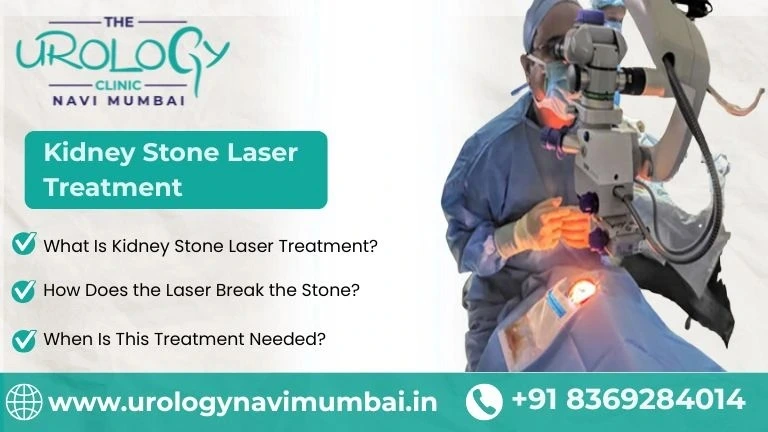
In basic terms, it’s a procedure where a laser is used to break the kidney stone into very small pieces. These small fragments are either taken out during the procedure or they pass naturally through urine later on.
There’s no open surgery involved. Doctors use a thin instrument called a ureteroscope, which goes through the natural urinary passage. That means no visible scars or stitches on the outside. For many patients, that’s a big relief.
Years ago, open surgeries were more common. Now, laser-based treatment is widely preferred because it’s safer and much less invasive.
A lot of patients worry and ask, “Is the laser going to damage my kidney?” That’s a very common fear.
The answer is no. The laser is extremely precise. It focuses only on the stone. The energy breaks the stone into tiny particles, almost like crushing it into powder. The surrounding kidney tissue remains safe.
The entire procedure is done under anesthesia. So you won’t feel pain during the treatment. Most patients later say they were surprised at how smooth the whole process felt.
Not every kidney stone requires surgery. Smaller stones often pass naturally with medication and good hydration.
However, laser treatment may be recommended if:
If the stone gets stuck in the ureter and causes constant pain, waiting may only make things worse. In such cases, going ahead with treatment is usually the better option.
This is probably the first thing patients ask.
During the procedure, you won’t feel pain because anesthesia is given. After the procedure, there might be slight burning while passing urine. Some people notice mild blood in the urine for a short time. It can look alarming, but it’s usually temporary.
Compared to the intense pain of a kidney stone attack, the discomfort after treatment is much easier to handle.
Typically, the procedure lasts between 30 minutes to 90 minutes. The exact time depends on the size and location of the stone.
Many patients are discharged the same day. In some cases, an overnight stay is advised for observation. But extended hospital stays are not common with this procedure.
That’s one reason why kidney stone laser treatment has become so popular — shorter hospital time and quicker recovery.
Recovery is usually straightforward, but you still need to follow medical advice carefully.
Doctors generally recommend:
In some cases, a temporary stent is placed inside the ureter to help urine flow smoothly. If a stent is inserted, you may feel a slight urge to urinate more often. It can be uncomfortable, but it’s temporary and usually removed within one or two weeks.
Most people return to their routine work within 2 to 5 days.
Like any medical procedure, there are small risks involved. Though serious complications are rare.
Possible side effects may include:
Choosing a well-equipped hospital and an experienced urologist reduces these risks significantly.
The success rate is generally high, especially for stones located in the ureter. Many patients become completely stone-free after just one session.
For very large or complex stones, an additional session might be needed. But overall, outcomes are positive and recovery is faster compared to older surgical techniques.
The cost of kidney stone laser treatment depends on several factors:
Most hospitals provide a clear estimate beforehand. If you have health insurance, the procedure is often covered under many policies.
Yes, they can return. And this is something many people overlook.
Removing a stone does not guarantee it won’t form again. Prevention plays a very important role. Doctors usually suggest:
Simple lifestyle changes can reduce the chances of recurrence significantly.
When it comes to kidney health, proper care makes all the difference.
Patients often look for:
Having everything managed under one roof makes the entire journey less stressful.
Kidney stones can be extremely painful and disruptive. Thankfully, medical advancements have made treatment much more comfortable than before.
Kidney stone laser treatment offers a minimally invasive option with strong success rates and faster healing. No major cuts, shorter hospital stays, and manageable recovery — these are the reasons many patients choose this method today.
If stone pain keeps returning or medication isn’t helping, timely treatment can prevent complications and bring relief sooner rather than later.
Most people go back to normal activities within 2–5 days. Physically demanding jobs may require a few extra days of rest.
Not always. It depends on the size and condition of the urinary tract. If placed, it is temporary.
For larger or harder stones, laser treatment is often more effective because the stone can be directly visualized and broken.
Yes. Drinking enough water and following dietary advice based on stone type helps prevent recurrence.
Many large stones can be treated in one sitting, but some complex cases may require additional sessions.
About The Urology Clinic Navi Mumbai
The Urology Clinic Navi Mumbai, led by Dr. Ninad Tamboli, a trusted urologist in Navi Mumbai, is your destination for expert urological care. Specializing in advanced treatments for urinary and reproductive health.
We’re here to assist you! Reach out to us for appointments, inquiries, or detailed information about our services:
At The Urology Clinic, we understand the importance of accessible and expert medical care. Led by Dr. Ninad Tamboli,
a highly experienced urologist in Navi Mumbai.